


Table of Contents
- Specialty Coffee vs Commodity Coffee: Where the Price Gap Starts
- The Supply Chain: Why Specialty Coffee Costs More From Farm to Cup
- Processing Methods and Roasting: The Cost of Craft
- Benefits of Freshly Roasted Coffee: What You're Actually Paying For
- How to Brew Fresh Coffee and Maximize Your Investment
- Value vs Cost: Is Specialty Coffee Worth the Price?
- Frequently Asked Questions
Specialty Coffee vs Commodity Coffee: Where the Price Gap Starts
Specialty coffee costs more because it's fundamentally different from commodity coffee. The difference isn't just marketing, it's rooted in how the beans are grown, processed, graded, and roasted. At Ed In Your Head, we focus on specialty-grade coffee because the quality and consistency matter for athletes and gamers who need reliable, clean energy without crashes.
Commodity coffee is the baseline. It's produced at scale, mixed from multiple origins, and graded by minimum standards. Specialty coffee, by contrast, is traceable to specific farms or regions, scored for quality using a standardized cupping process, and handled with precision at every step. A single-origin specialty coffee might come from one farm in Ethiopia or Guatemala, while a commodity blend could contain beans from dozens of sources blended together for volume and cost efficiency.
The gap between these two categories explains most of what you'll pay extra for. Specialty coffee typically sells for $12-$16 per pound at retail, while commodity coffee averages $6-$8. That's not a small difference, and understanding where it comes from helps you decide if the premium is worth your money.
The Supply Chain: Why Specialty Coffee Costs More From Farm to Cup
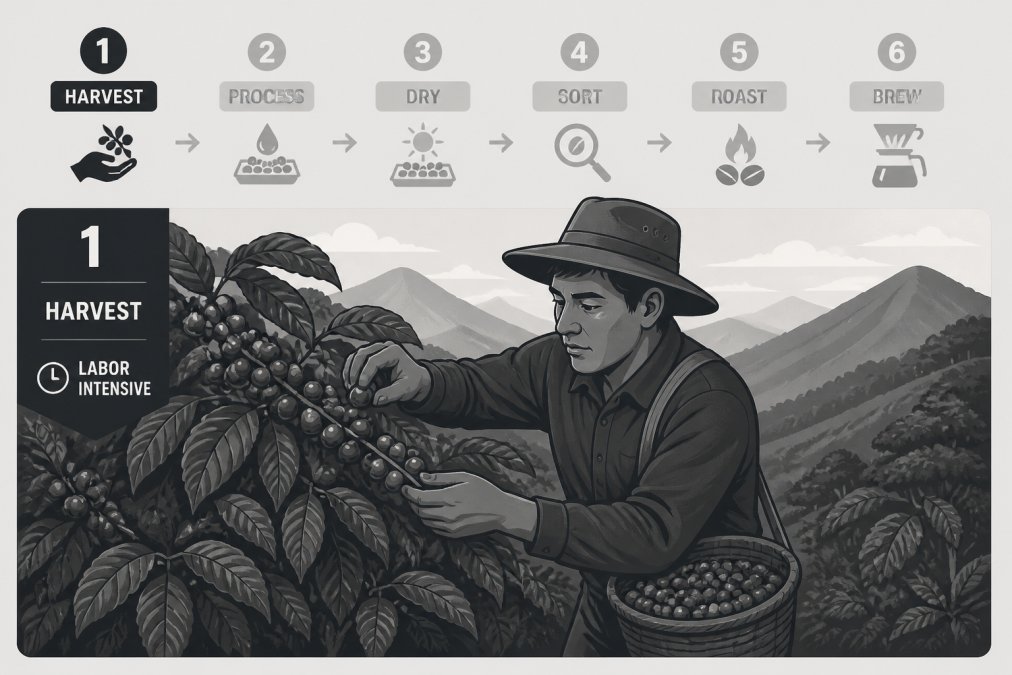
The supply chain for specialty coffee is more expensive at nearly every step. From the farmer's harvest to your cup, specialty coffee requires more labor, more care, more documentation, and more selective handling than commodity coffee.
Quality Control and Grading Standards
Specialty coffee is graded using the Specialty Coffee Association (SCA) cupping score, a standardized 100-point scale that evaluates flavor, aroma, body, acidity, and overall quality (sca.coffee). Beans scoring 80 points or higher qualify as specialty grade (sca.coffee). This grading process requires trained cuppers and controlled tasting environments, costs that commodity coffee avoids entirely.
Quality control also means rejecting defective beans. Specialty coffee producers sort out discolored, damaged, or immature beans by hand or machine before export. Commodity coffee tolerances are much looser. A single batch of specialty coffee might have 1-2% defects, while commodity batches accept 5-10%. That selective sorting adds labor and reduces yield per harvest, raising the per-pound cost.
Traceability is another quality control layer. Specialty coffee is tracked from farm to importer to roaster, with documented lot numbers and harvest dates. Commodity coffee is often pooled and blended, losing that chain of custody. Maintaining traceability requires record-keeping systems, testing, and verification that commodity producers skip.
Direct Trade and Fair Wages for Farmers
Many specialty coffee roasters work through direct trade relationships, buying beans directly from farmers rather than through commodity brokers. Direct trade means the farmer gets a higher price per pound, often 2-3 times what commodity farmers receive, because the roaster cuts out middlemen and shares more of the retail price with the source.
Fair wages for coffee farmers matter in specialty coffee economics. A farmer growing commodity coffee might earn $1.50-$2.00 per pound of green beans. A specialty coffee farmer working with a direct trade roaster might earn $4.00-$6.00 per pound. That higher farmer income is built into the specialty coffee price you see at checkout.
This also affects consistency. When farmers are paid fairly for quality, they invest in better farming practices, equipment, and processing methods. They're incentivized to produce excellent beans, not just volume. That commitment to quality is what makes specialty coffee taste better, and cost more.
Transportation and Logistics
Specialty coffee requires more careful handling during transport. Beans are typically shipped in climate-controlled containers, sometimes with humidity monitoring, to prevent moisture loss or mold. They're often shipped in smaller quantities than commodity coffee, which means higher per-pound shipping costs.
Specialty importers also pay for faster shipping timelines. Commodity coffee can sit in warehouses for months; specialty coffee is moved quickly to preserve freshness. Expedited shipping and handling add to the final cost.
Storage and warehousing for specialty coffee is also more controlled. Temperature and humidity must stay within narrow ranges to protect the beans' quality. These controlled facilities cost more to operate than the standard warehouses used for commodity coffee.
Processing Methods and Roasting: The Cost of Craft
How coffee is processed after harvest dramatically affects both flavor and price. Specialty coffee roasters invest in specific processing methods and small-batch roasting techniques that commodity producers avoid because they're labor-intensive and reduce throughput.
Small-Batch Roasting vs Industrial Production
Small-batch roasting is one of the biggest cost drivers in specialty coffee. Ed In Your Head roasts every order to order, meaning your beans are roasted the day they ship. This approach guarantees maximum freshness but requires constant roasting throughout the day rather than one massive roast run.
Industrial commodity roasting is the opposite. A facility roasts hundreds of pounds at once, cools them, bags them, and ships them. That economy of scale reduces per-pound roasting costs significantly. Small-batch roasting requires more labor, more frequent equipment maintenance, and lower throughput per hour of operation.
Specialty roasters also roast at lower temperatures and longer timeframes to develop flavor complexity. Commodity roasters often use higher heat and faster cycles to maximize output. The specialty approach extracts more nuanced flavors but requires more skill, attention, and time.
Freshness and Roast-to-Order Premium
Roast-to-order coffee commands a premium because it's fresher. Coffee peaks in flavor 5-14 days after roasting and begins to decline after that (peer-reviewed research). Roast-to-order guarantees your coffee is in that optimal window when it arrives.
Commodity coffee, by contrast, is often roasted weeks or months before you buy it. The flavor has already started fading. Some grocery store coffee is roasted 3-6 months before purchase. That staleness doesn't affect the price, it just means you're paying commodity prices for degraded quality.
The freshness premium reflects the cost of roasting on demand: labor, scheduling complexity, and inventory management. Ed In Your Head's roast-to-order model means higher operational costs, which is reflected in the price. You're paying for coffee that tastes better because it's fresher, not because of marketing.
Benefits of Freshly Roasted Coffee: What You're Actually Paying For
When you pay more for specialty coffee, you're buying tangible benefits that commodity coffee doesn't deliver. Freshness is the most obvious, but there are others worth understanding.
Flavor complexity is real. Specialty coffee has distinct tasting notes, berry, chocolate, floral, citrus, that commodity coffee lacks. Those flavors come from the origin (terroir), the processing method, and the roast profile. They're not added; they're unlocked through careful handling. Commodity coffee is often described as "neutral" or "smooth" because the flavor profile is intentionally flattened to appeal to mass markets.
Consistency is another benefit. A specialty coffee from the same farm and roaster tastes the same batch to batch. Commodity coffee blends vary because the sources change with market availability. If you like a specific flavor, specialty coffee lets you find it and stick with it.
For athletes and gamers, the quality of the caffeine delivery matters too. Specialty coffee typically contains 95-200mg of caffeine per 8oz cup, depending on the roast and brew method. More importantly, the caffeine is released gradually through better extraction, supporting sustained focus without the jitters or crash that lower-quality coffee causes. The acids and compounds in specialty coffee are better balanced, making it easier on your stomach and more stable for extended focus sessions.
How to Brew Fresh Coffee and Maximize Your Investment
Once you've invested in specialty coffee, brewing it correctly ensures you get the full benefit. Poor brewing can waste even excellent beans.
Start with water temperature between 195-205°F. Boiling water (212°F) over-extracts and tastes bitter. Water cooler than 195°F under-extracts and tastes sour. If you don't have a thermometer, let boiling water cool for 30 seconds before brewing.
Grind size matters more than most people realize. Finer grinds extract faster; coarser grinds extract slower. For espresso, you need a fine, consistent grind. For pour-over, medium-fine works well. For French press, use a coarse grind. Grinding right before brewing preserves flavor, pre-ground coffee loses volatile compounds within hours.
Brew time depends on your method. Espresso: 25-30 seconds. Pour-over: 3-4 minutes. French press: 4 minutes. Cold brew: 12-24 hours. Timing affects extraction balance. Too fast and you miss sweetness; too slow and bitterness dominates.
Use a 1:16 coffee-to-water ratio as a starting point. That's 1 gram of coffee to 16 grams of water. Adjust up or down based on taste preference. Most people under-dose coffee, using too little, which results in weak, sour cups.
Water quality matters. Filtered or spring water works best. Tap water with high chlorine or mineral content affects flavor. Distilled water is too pure and can taste flat.
Store your beans in an airtight container away from light and heat. Whole beans stay fresh for 2-4 weeks after roasting. Once ground, use within 15 minutes for best results. Freezing whole beans extends freshness, but avoid repeatedly thawing and refreezing.
Value vs Cost: Is Specialty Coffee Worth the Price?
The question isn't whether specialty coffee is more expensive, it clearly is. The question is whether the value justifies the cost for your situation.
If you drink one cup of coffee per day, specialty coffee costs roughly $0.50-$0.75 per cup. Commodity coffee costs $0.20-$0.30 per cup. Over a year, that's a $100-$200 difference. For most people, that's a meaningful amount.
The value proposition shifts based on how you use coffee. If coffee is a daily necessity for focus and performance, specialty coffee's consistency and quality matter more. Athletes and gamers relying on coffee for sustained energy during competitions or long sessions benefit from the smoother caffeine delivery and lack of jitters. The premium pays for reliability you can count on.
If coffee is occasional or purely social, commodity coffee is probably fine. You're not relying on it for performance, so the flavor complexity and freshness matter less.
For Ed In Your Head customers, the value equation includes another layer: the product is formulated specifically for athletes and gamers. Our Coffee with Mushrooms blends (available in medium roast and dark roast) combine specialty coffee with Lion's Mane, Cordyceps, and Reishi mushrooms to support sustained focus and mental clarity. That's a targeted benefit beyond what standard specialty coffee offers.


If you're comparing specialty coffee to energy drinks, the value case is even clearer. Energy drinks typically cost $2-$4 per serving and contain 80-300mg of caffeine plus added sugars and artificial ingredients. Specialty coffee costs $0.50-$0.75 per serving, delivers clean caffeine without sugar or artificial additives, and tastes better. The premium over commodity coffee becomes negligible when you're replacing energy drinks.
| Factor | Commodity Coffee | Specialty Coffee | Ed In Your Head |
|---|---|---|---|
| Price per cup | $0.20-$0.30 | $0.50-$0.75 | $0.65-$0.90 |
| Freshness | Weeks to months | 5-14 days optimal | Roasted to order |
| Flavor profile | Neutral, flat | Complex, distinct | Complex + functional benefits |
| Quality control | Loose (5-10% defects) | Strict (1-2% defects) | SCA 80+ specialty grade |
| Caffeine delivery | Quick spike, crash | Steady, sustained | Steady + mushroom support |
| Best for | Budget-conscious drinkers | Quality-focused coffee lovers | Athletes, gamers, performance seekers |
The real answer is this: specialty coffee is worth the price if you value consistency, flavor, freshness, and performance. It's not worth it if you're indifferent to taste or only drink coffee occasionally. For anyone using coffee as a tool for focus or energy, which includes athletes, gamers, and busy professionals, specialty coffee's premium is justified by tangible benefits you'll notice immediately.
The price of specialty coffee reflects real differences in sourcing, processing, quality control, and freshness. When you understand where that cost comes from, the premium makes sense. If you're serious about performance and need reliable, clean energy without crashes, specialty coffee delivers value that commodity coffee can't match. Find your fuel with Ed In Your Head's fresh-roasted specialty blends, including our Italian Roast and Whiskey Barrel Aged single-origin, roasted to order and crafted for sustained focus and smooth energy.

Frequently Asked Questions
Q: What is the difference between specialty coffee and commodity coffee?
A: Specialty coffee comes from single-origin farms with documented traceability, cupping scores of 80+, and strict quality control. Commodity coffee blends beans from multiple sources with no traceability and focuses on volume over quality. Specialty coffee farmers receive fair wages and direct trade premiums; commodity coffee farmers typically earn significantly less. The flavor profile in specialty coffee is complex and distinct, while commodity coffee offers consistency but minimal flavor complexity.
Q: Why does specialty coffee cost more than commodity coffee?
A: Specialty coffee costs more due to five main factors: higher labor costs for selective hand-harvesting, stricter quality control and grading standards, fair trade and direct trade pricing that ensures living wages for farmers, small-batch roasting instead of industrial production, and freshness premiums from roasting to order. A bag of specialty coffee might cost $24-$26, while commodity coffee costs $6-$10 per pound. The price reflects transparency throughout the supply chain and superior flavor quality.
Q: Is the higher price of specialty coffee reflected in the flavor?
A: Yes. Specialty coffee delivers noticeably different flavor profiles because beans are grown at higher altitudes, harvested at peak ripeness, and processed with precision. Washed and natural processing methods are controlled to highlight origin characteristics. Freshly roasted specialty coffee retains aromatics and subtle flavors that fade in commodity coffee stored for weeks. If you've only had commodity coffee, the first cup of fresh-roasted specialty coffee will taste dramatically different, cleaner, brighter, with distinct flavor notes instead of generic 'coffee' taste.
Q: How does roasting affect specialty coffee pricing?
A: Small-batch roasting costs more than industrial roasting because it requires skilled roasters, smaller equipment, and frequent production runs. Roasting to order, where beans are roasted the day they ship, ensures maximum freshness but increases labor and logistics costs. Industrial roasters produce hundreds of pounds at once and store finished coffee for weeks, reducing per-unit costs but sacrificing flavor. Specialty roasters invest in equipment and expertise to bring out origin characteristics; commodity roasters prioritize speed and volume.
This article was written using GrandRanker