


Table of Contents
- What You'll Need Before You Brew Fresh Coffee
- Coffee Brewing Ratios: The Foundation of Every Good Cup
- Best Coffee Grind Size for Brewing Each Method
- Water Temperature, Quality, and Their Effect on Extraction
- Step-by-Step Brewing Methods to Brew Fresh Coffee
- How to Store Fresh Roasted Coffee to Protect Flavor
- Common Brewing Mistakes and How to Fix Them
- Conclusion
Last Updated: August 17, 2026
What You'll Need Before You Brew Fresh Coffee
Most guides skip straight to brewing steps and wonder why the cup tastes flat. The real problem starts before you heat water. Learning to brew fresh coffee the right way means getting the setup right first, and Ed In Your Head was built around exactly that principle: every order roasted the day it ships, because freshness is the foundation of every good cup.
Two things determine coffee quality before technique: your equipment and your beans. Get those wrong and no amount of careful pouring will save you.
Gear That Actually Matters
You don't need an expensive setup. You need the right tools.
- Burr grinder: Produces uniform particle sizes, the single most important hardware upgrade. Blade grinders create a mix of fine powder and coarse chunks that extract unevenly, producing bitterness and sourness simultaneously.
- Kitchen scale: A basic digital scale that reads in grams removes the biggest variable in your brew.
- Gooseneck kettle: Essential for pour-over. The narrow spout gives precise control over flow rate and water distribution.
- Thermometer or temperature-controlled kettle: Water temperature matters more than most realize.
- Timer: A phone timer works fine.
That's the core kit. Everything else is optional.
Choosing Your Beans: Roast Profiles and Freshness
Freshly roasted coffee beans are not the same as coffee roasted six months ago and stored in a warehouse. The difference is measurable in the cup.
Light roasts preserve origin character, producing higher acidity and complex tasting notes like fruit and florals. They require slightly higher water temperatures and finer grind sizes to extract fully.
Medium roasts balance acidity and body, with tasting notes leaning toward chocolate, caramel, and nuts. These are the most forgiving to brew across different methods.
Dark roasts reduce acidity and increase body and bitterness. They extract faster, requiring coarser grinds and slightly lower temperatures to avoid over-extraction.
The roast date matters as much as the roast level. Coffee hits peak flavor between days 5 and 21 after roasting. After that, oxidation steadily strips the cup of its best qualities. Buy beans with a roast date on the bag, not a "best by" date.
Coffee Brewing Ratios: The Foundation of Every Good Cup
Coffee brewing ratios define the relationship between ground coffee and water. The standard starting point across most brewing methods is a 1:15 to 1:17 ratio by weight, meaning 1 gram of coffee for every 15 to 17 grams of water.
| Brewing Method | Coffee (grams) | Water (grams) | Ratio |
|---|---|---|---|
| Pour-Over | 20g | 300g | 1:15 |
| French Press | 30g | 500g | 1:16 |
| AeroPress | 15g | 225g | 1:15 |
| Moka Pot | Fill basket | Fill to valve | N/A (pressure-driven) |
| Drip Coffee Maker | 60g | 1,000g | 1:16 |
| Cold Brew | 100g | 800g | 1:8 |
A higher ratio produces a lighter, more delicate cup. A lower ratio produces something stronger and more concentrated. Start at 1:15 and adjust based on your taste.
The most common mistake is using volume measurements instead of weight. A tablespoon of finely ground coffee weighs significantly more than a tablespoon of coarsely ground coffee. Weight removes that inconsistency entirely.
Best Coffee Grind Size for Brewing Each Method
Grind size controls extraction rate. Finer grounds have more surface area, so water pulls flavor faster. Coarser grounds extract more slowly. Match your grind to your brew time, and you'll hit the extraction sweet spot.
- Extra coarse (cold brew): Chunky, like rough sea salt. Long steep times need slow extraction.
- Coarse (French press): Resembles coarse ground pepper. Prevents grounds from slipping through the metal filter.
- Medium-coarse (Chemex): Slightly finer than French press. The thick filter slows flow.
- Medium (drip coffee maker): The standard grocery store grind.
- Medium-fine (pour-over, V60): Like table salt. Balances flow rate and extraction time.
- Fine (AeroPress, stovetop espresso): Similar to granulated sugar. Short brew times need fast extraction.
- Extra fine (espresso machine): Powder-like, 200-400 microns. Requires precise tamping and pressure.
Grind consistency matters as much as grind size. A burr grinder produces dramatically more consistent results than a blade grinder.

Water Temperature, Quality, and Their Effect on Extraction
Water temperature is where most home brewers leave real quality on the table. The Specialty Coffee Association's brewing standards recommend water between 195°F and 205°F (90°C to 96°C) for optimal extraction. Below 195°F, you under-extract, producing a sour, thin cup. Above 205°F, you risk scorching the grounds and pulling harsh, bitter compounds.
Light roasts need the higher end of that range (200-205°F) because their dense cell structure requires more energy to extract. Dark roasts extract more readily, so 195-200°F prevents over-extraction and bitterness.
Water quality is the variable almost no guide covers. Your water is roughly 98% of your cup. If it tastes bad from the tap, your coffee will taste bad.
Hard water contains high levels of calcium and magnesium. These minerals can enhance extraction up to a point, but excessive hardness causes scale buildup and can make coffee taste flat or chalky. A simple carbon filter improves both cup quality and equipment longevity.
Soft water lacks the minerals that aid extraction. Distilled or reverse-osmosis water produces flat, lifeless coffee. Total dissolved solids (TDS) in the 75-150 ppm range is the sweet spot for brewing.
The practical fix for most people: use filtered tap water. It removes chlorine and sediment without stripping beneficial minerals. Avoid distilled water entirely.
Step-by-Step Brewing Methods to Brew Fresh Coffee
The method you choose shapes everything: brew time, body, acidity, and how much control you have over the final cup. The best method is the one you'll actually use consistently.
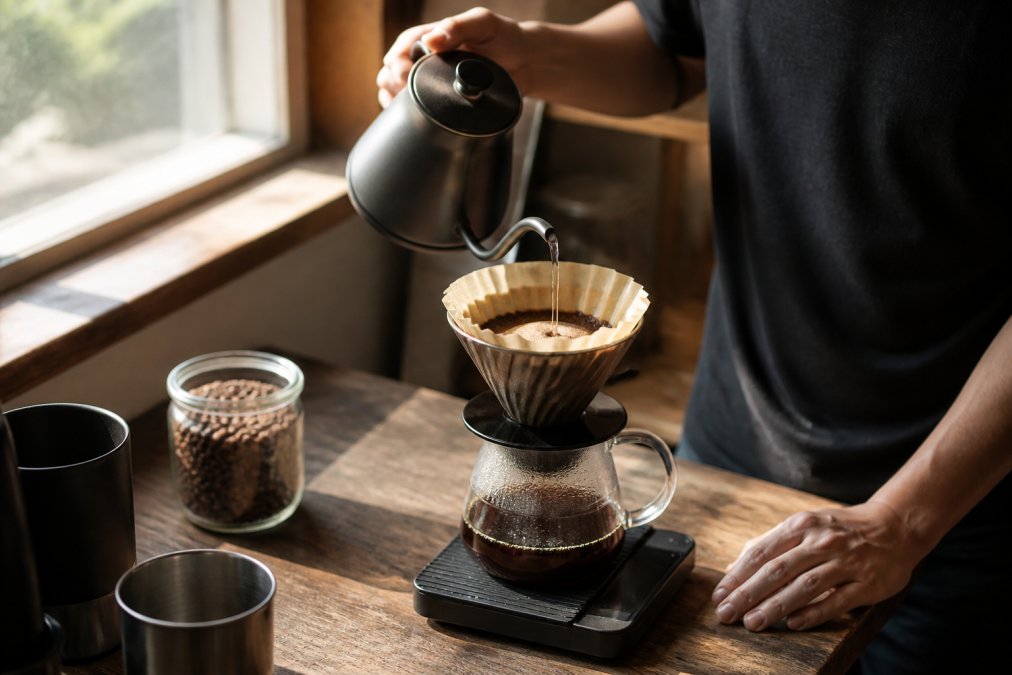
Pour-Over
Pour-over is immersion and filtration combined. Hot water passes through a bed of grounds and filter paper, producing a clean, bright cup with distinct tasting notes.
You'll need: Pour-over dripper (V60, Chemex, or similar), paper filter, gooseneck kettle, scale, timer, mug or carafe.
- Heat water to 200-205°F.
- Rinse the filter paper with hot water to remove paper taste and preheat the dripper. Discard the rinse water.
- Add 20g of medium-fine ground coffee to the filter.
- Start your timer and pour 40g of water over the grounds to bloom. Wait 30-45 seconds.
- Continue pouring in slow, steady spirals, adding water in 50-60g increments.
- Total brew time should land between 2:30 and 3:30. If faster, grind finer. If slower, grind coarser.
- Total water: 300g.
French Press
French press is full immersion brewing. The metal filter lets oils and fine particles pass through, producing a heavier body than pour-over. It's forgiving and produces a consistently satisfying cup with minimal technique.
- Heat water to 195-200°F.
- Add 30g of coarsely ground coffee to the press.
- Pour 500g of water over the grounds. Stir gently to ensure all grounds are saturated.
- Place the lid on (plunger up) and steep for 4 minutes.
- Press the plunger down slowly and steadily. Pressing too fast forces fine particles through the filter.
- Pour immediately. Leaving coffee in the press continues extraction and turns the cup bitter.
AeroPress
The AeroPress is the most flexible brewer on this list. Short brew times, easy cleanup, and forgiving variables make it ideal for travel or fast morning brews.
- Heat water to 195-205°F.
- Place a filter in the cap, rinse with hot water, and attach to the chamber.
- Add 15g of fine-to-medium-fine ground coffee.
- Pour 225g of water and stir for 10 seconds.
- Steep for 1-1:30 minutes.
- Press the plunger down slowly over 30 seconds.
Moka Pot
The moka pot uses steam pressure to push water through finely ground coffee, producing a concentrated, espresso-adjacent brew. It doesn't reach true espresso pressure, but the result is strong and excellent as a base for milk-based drinks.
- Fill the bottom chamber with cold water up to the pressure relief valve.
- Fill the filter basket with finely ground coffee. Level it off without tamping.
- Screw the top chamber on firmly.
- Place on medium-low heat. Too high and the coffee scorches before it brews.
- When you hear a hissing, gurgling sound, the brew is nearly done. Remove from heat immediately.
Drip Coffee Maker
Drip coffee makers are the most common brewing method in American households, but they're also the most neglected. A dirty machine produces bitter, stale-tasting coffee regardless of bean quality.
According to the Specialty Coffee Association's home brewer certification program, a properly calibrated drip machine should brew at 200°F and complete the brew cycle in 4-8 minutes.
- Use 60g of medium-ground coffee per 1,000g (roughly 1 liter) of water.
- Use filtered water.
- Run a brew cycle with only water and white vinegar (50/50) monthly to descale the machine.
- Replace the paper filter every brew. Reusing filters causes stale, papery-tasting coffee.
How to Store Fresh Roasted Coffee to Protect Flavor
Fresh roasted coffee has four enemies: oxygen, moisture, light, and heat. Knowing how to store fresh roasted coffee correctly extends peak flavor from days to weeks.
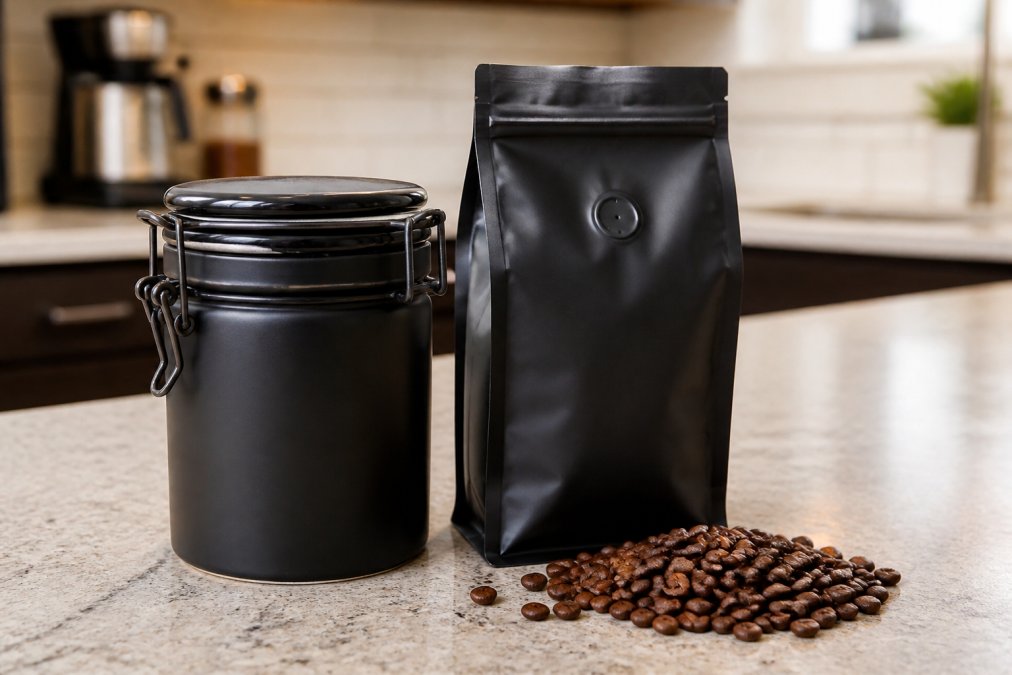
The best storage method is an airtight container with a one-way valve, kept at room temperature in a dark cabinet. The one-way valve allows CO2 to escape without letting oxygen in.
What to avoid:
- The refrigerator: Coffee absorbs surrounding odors readily and is exposed to moisture and temperature fluctuations.
- Clear canisters on the counter: Light degrades flavor compounds. Use an opaque container.
- The freezer (for daily-use coffee): Repeatedly freezing and thawing damages cell structure and introduces moisture.
Buy in quantities you'll use within 2-3 weeks of the roast date. That's the simplest, most effective storage strategy: buy fresh, buy often.
Common Brewing Mistakes and How to Fix Them
The most common brewing mistakes aren't about technique. They're about variables people don't think to question.
| Mistake | What's Happening | Fix |
|---|---|---|
| Coffee tastes bitter | Over-extraction or too-hot water | Grind coarser, lower water temp, or shorten brew time |
| Coffee tastes sour/weak | Under-extraction | Grind finer, raise water temp, or extend brew time |
| Coffee tastes flat | Stale beans or poor water | Buy fresher beans, use filtered water |
| Inconsistent cup daily | No scale, inconsistent grind | Weigh coffee and water every brew |
| Grounds in the cup | Wrong grind for method | Grind coarser for French press; check filter seal on AeroPress |
| Bitter drip coffee | Dirty machine | Descale monthly, replace filters every brew |
Skipping the bloom. The bloom step in pour-over isn't optional. Freshly roasted coffee releases significant CO2, and if you don't let it off-gas before the main pour, you get uneven extraction and a dull cup. Give it 30-45 seconds.
Using too little coffee. Weak coffee is almost always a ratio problem, not a grind problem. Start with a proper 1:15 ratio and adjust from there.
Brewing with tap water in a hard-water area. If your tap water leaves white deposits on your kettle, it's affecting your coffee. A basic carbon filter pitcher costs very little and makes a measurable difference.
Grinding the night before. Ground coffee stales fast. Whole beans hold their flavor significantly longer. Grind immediately before brewing, every time.
For those who want to go deeper on the science behind extraction, the Coffee Science Foundation's research on extraction chemistry provides detailed breakdowns of how different variables interact at the molecular level.
Brewing consistently good coffee comes down to controlling the variables that most people ignore: ratio, grind consistency, water temperature, and bean freshness. Fix those four things and the method matters far less than you think. Ed In Your Head makes the freshness part straightforward: beans roasted the day they ship, zero added sugar, no jitters, and clean caffeine that gives you steady energy without the crash. Whether you're fueling a long gaming session or an early morning workout, start with fresh beans and the rest follows. Find your fuel at Ed In Your Head and taste the difference a roast date makes.
Frequently Asked Questions
Does the roast date affect how to brew fresh coffee?
Yes, significantly. Freshly roasted beans release CO2 for several days after roasting, which can interfere with extraction if you brew too soon. Most specialty roasters recommend a rest period of 3 to 7 days for espresso and 1 to 3 days for filter methods. Beans older than 4 to 6 weeks past roast date produce noticeably flat, dull cups. Buying coffee roasted to order, like Ed In Your Head's beans roasted the day they ship, removes this guesswork entirely.
What is the best coffee-to-water ratio for home brewing?
The standard starting point is 1:15 to 1:17 by weight, meaning 1 gram of coffee for every 15 to 17 grams of water. For a 12-ounce mug (about 340 grams of water), that works out to roughly 20 to 23 grams of coffee. Pour-over and drip methods typically sit around 1:16, while immersion methods like French press and AeroPress often work better at 1:12 to 1:15 for a fuller body. A kitchen scale gives you repeatable results far more reliably than scoops.
How does water temperature impact coffee extraction?
Water between 195°F and 205°F extracts the full range of soluble compounds from coffee grounds. Water below 195°F under-extracts, leaving the cup sour and thin. Water above 205°F over-extracts, pulling bitter compounds that overwhelm the tasting notes. If you don't have a thermometer, let boiling water rest for 30 to 45 seconds before pouring. Cold brew is the exception, using room temperature or refrigerator-cold water over 12 to 24 hours to produce a low-acid, smooth concentrate.
What grind size should I use for different brewing methods?
Grind size controls how fast water flows through coffee grounds and how much surface area is exposed for extraction. Espresso needs extra-fine grounds, similar to powdered sugar. Moka pot uses fine. Drip machines and pour-over work best with medium to medium-fine. French press needs coarse grounds to avoid sediment slipping through the metal filter. AeroPress is flexible, but medium-fine is a reliable default. A burr grinder produces consistent particle sizes across all these settings; a blade grinder does not.
This article was written using GrandRanker