


Table of Contents
- Why Fresh Roasted Coffee Tastes Better Than Stale Beans
- What "Fresh" and "Stale" Actually Mean in the Cup
- The Coffee Degassing Process Explained: Why Beans Need Time
- Oxidation, Aromatic Compounds, and the Roast Date Label
- How to Store Coffee Beans for Maximum Freshness at Home
- How to Brew Fresh Coffee: Adjusting for a Moving Target
- Spotting Stale Coffee: Visual and Olfactory Clues
- Why Grocery Store Coffee Often Underperforms
- Conclusion
- Frequently Asked Questions
Last Updated: September 29, 2026
Why Fresh Roasted Coffee Tastes Better Than Stale Beans
Fresh roasted coffee tastes better because its volatile aromatic compounds are still intact, and the beans are still releasing carbon dioxide at a rate that protects them from oxygen damage. At Ed In Your Head, every order is roasted the day it ships. A bean roasted last week and one roasted six months ago can come from the same farm, variety, and processing method, and still taste like two completely different products.
What "Fresh" and "Stale" Actually Mean in the Cup
Fresh coffee is coffee still inside its flavor window, actively releasing carbon dioxide and retaining its volatile oils. Stale coffee is coffee that has lost those compounds to oxidation and time, producing flat, papery, or cardboard-like flavors.
- Aromatic compounds still present in the bean
- Carbon dioxide still venting, which slows oxygen contact
- Volatile oils not yet evaporated or oxidized
The Coffee Degassing Process Explained: Why Beans Need Time
The coffee degassing process is the release of carbon dioxide trapped inside beans during roasting, escaping slowly over days to weeks after the roast.
The Resting Period: Finding the Sweet Spot by Brewing Method
Different brewing methods need different resting periods because they extract differently. Here's a practical starting point:
| Brewing Method | Ideal Rest After Roast | Why |
|---|---|---|
| Espresso | 5-14 days | Needs full degassing for stable crema and pressure |
| Pour-over | 3-10 days | Bloom settles, flavor profile becomes balanced |
| French press | 4-10 days | Full immersion tolerates less rest |
| Cold brew | 7-14 days | Long extraction, less sensitive to gas |
| Drip | 3-7 days | Fastest window, drink it early |
Oxidation, Aromatic Compounds, and the Roast Date Label
Oxygen is the primary enemy of coffee flavor. Once beans are exposed to air, oxygen breaks down the volatile oils that carry tasting notes like dried orange, dark chocolate, or berry, and heat, light, and moisture accelerate that process.
How to Store Coffee Beans for Maximum Freshness at Home
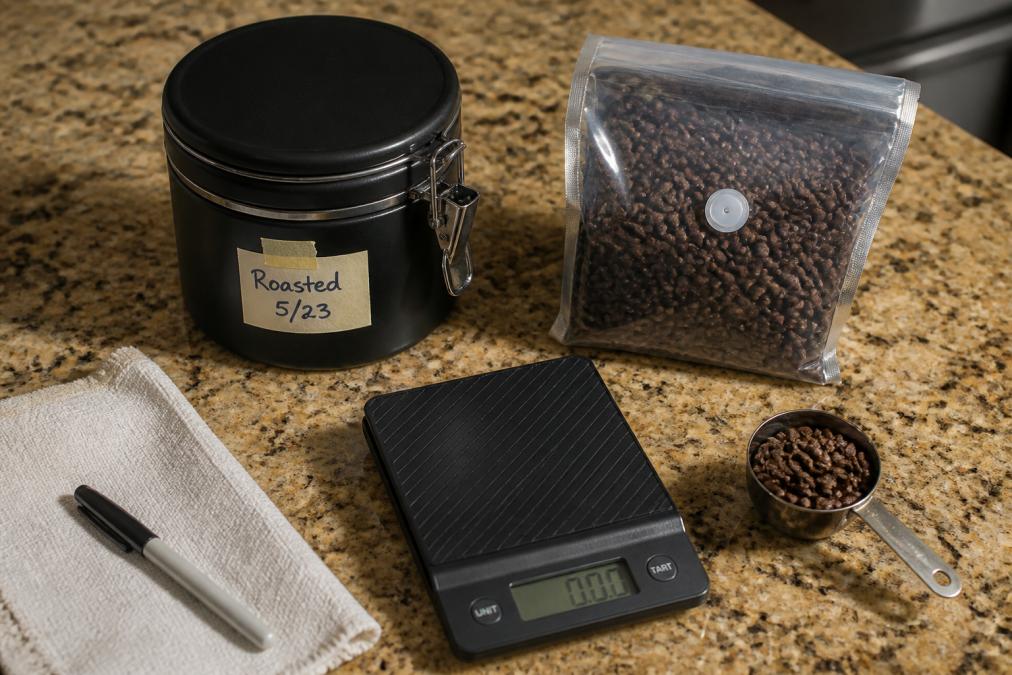
The best way to store coffee beans for maximum freshness is in an opaque, airtight container kept away from heat, light, and moisture, ideally in the original valve bag or transferred whole. Whole beans stay fresh far longer than ground coffee because less surface area is exposed to oxygen.
Why Roast Level Changes the Storage Clock
Darker roasts spend longer in the roaster, and that extra heat makes the bean structure more porous, so carbon dioxide escapes faster and oxygen gets in faster. Lighter roasts are denser, degas more slowly, and hold their aromatic compounds longer. A dark roast might peak around day four to seven and taste flat by day fourteen, while a light roast may not hit its stride until day seven and still taste vibrant at day twenty-one.
Vacuum Sealing vs. Valve Bags vs. Freezing
Here's how the main storage methods compare in practice:
- One-way valve bags. The standard roaster bag lets carbon dioxide out without letting oxygen in. It works well for the first two to three weeks, but every time you open the bag, you exchange the headspace air.
- Vacuum sealing. Pulling a vacuum removes oxygen, which slows oxidation dramatically. The trade-off is that a hard vacuum can crush the bean structure and force out volatile oils along with the air, and if you seal beans while they're still actively degassing, the bag can balloon or the seal can fail. Vacuum sealing works best on beans that have already rested five to seven days.
- Freezing. Freezing is the most effective long-term method when done correctly. Portion beans into airtight bags, press out as much air as possible, and freeze immediately after the rest period. Grind from frozen without thawing, because thawing introduces condensation onto the bean surface. Frozen beans taste noticeably fresher at day thirty than beans kept in a valve bag at room temperature.
Home Storage Experiments Worth Running
You don't need lab equipment to see how storage changes flavor. Split a fresh bag into four portions on day one: one in the original valve bag, one in a glass jar with a loose lid, one vacuum-sealed, and one sealed in the freezer. Brew all four on day ten and taste them side by side.
Four rules still cover the basics:
- Keep beans whole until brewing. Grinding exposes oils to oxygen immediately.
- Use an airtight container or the original valve bag. One-way valves let carbon dioxide out without letting oxygen in.
- Store at room temperature, not the fridge. Condensation and odor transfer are real problems.
- Buy in quantities you'll finish. A two-week supply beats a two-month supply every time.
How to Brew Fresh Coffee: Adjusting for a Moving Target
Brewing fresh coffee well means adjusting your recipe as the beans age. A recipe that produces a perfect cup on day four will taste different on day twelve.
Three variables to watch:
- Grind size. As beans degas, they extract faster. You may need to grind slightly coarser over time.
- Bloom time. Fresher beans need a longer bloom. Give them 30-45 seconds to release gas before the main pour.
- Water temperature. Slightly cooler water (around 195-200°F) helps control extraction on very fresh beans.
Spotting Stale Coffee: Visual and Olfactory Clues
Stale coffee announces itself before you brew it. Learning the visual and olfactory indicators saves you from wasting time on a bag that's already gone.
Why Grocery Store Coffee Often Underperforms
Grocery store coffee underperforms because of time, not quality. By the time a bag reaches the shelf, it may have been roasted weeks or months earlier, shipped through distribution, and sat in a warehouse. Even excellent green coffee can't survive that timeline.
The Freshness Calendar: Why the "Best" Day Depends on How You Brew
There is no single freshness window. The right day to brew depends on your brewing method, because each method extracts differently and tolerates carbon dioxide differently.
- Espresso needs the most rest. Five to fourteen days after roast is the sweet spot. Brew too soon and the carbon dioxide fights the pressure, giving you fast, sour, thin shots with unstable crema.
- Pour-over can be brewed sooner, often three to ten days after roast. The bloom gives the gas somewhere to go, and the flavor profile settles into balance quickly.
- French press tolerates less rest, roughly four to ten days, because full immersion is more forgiving of residual gas.
- Cold brew is the most forgiving, seven to fourteen days, since the long, slow extraction smooths over early degassing.
- Drip has the shortest window, three to seven days. Drink it early.
How to Tell If Grocery Coffee Is Already Stale
You can spot stale beans before you brew them:
- Smell. Fresh beans smell sweet, complex, and specific. Stale beans smell flat, dusty, or like cardboard.
- Look. Fresh beans have a slight sheen from surface oils, especially on medium-dark and dark roasts. Stale beans look dry and matte.
- Bloom. Pour hot water over the grounds. A vigorous, bubbling bloom means the beans are still releasing carbon dioxide. A flat, quiet bloom means they've largely finished degassing and are on the decline.
- Crema. In espresso, fresh beans produce a thick, persistent crema. Stale beans produce a thin, pale, fast-collapsing crema.
- Cup. Stale coffee has a short finish, no acidity, and a papery aftertaste. The flavors collapse into a single dull note rather than developing across the sip.
If a grocery bag fails two or more of these checks, no grind adjustment will save it.
Conclusion
The hard part isn't learning that fresh coffee tastes better. It's building a routine that keeps you inside the freshness window, adjusting your brew as beans age, and buying from someone who actually tells you when the coffee was roasted.
Frequently Asked Questions
Does freshly roasted coffee actually taste better?
Yes, and the difference is measurable in the cup. Fresh roasted coffee still holds its aromatic compounds and volatile oils, which carry the tasting notes you read on the bag. As those compounds fade, the coffee turns flat, papery, and sometimes rancid. The catch is timing: beans need a few days to release carbon dioxide before they brew well. Peak drinking usually lands somewhere between 4 and 21 days after the roast date, depending on how you brew it.
How long does coffee stay fresh after roasting?
Whole beans hold their best flavor for roughly 2 to 4 weeks after roasting when stored in an airtight container away from light, heat, and moisture. Pre-ground coffee moves much faster, losing most of its aroma within days because the surface area exposed to oxygen jumps dramatically. Freezing whole beans in a sealed bag can stretch quality to about 2 months. Past that window, coffee is safe to drink but tastes dull and woody.
How does oxidation affect coffee bean flavor profiles?
Oxygen reacts with the volatile oils on the bean surface and inside the cell structure, breaking them down into compounds that read as cardboard, chalk, or stale bread. The bright acidity and fruit-forward notes go first, which is why old coffee tastes flat rather than simply weak. A one-way valve bag slows this by letting carbon dioxide escape without letting oxygen in. Once you open the bag, the clock speeds up considerably.
Why does store-bought coffee lose its flavor so quickly?
Most grocery shelf coffee is roasted months before you buy it, and the roast date is often missing or replaced with a vague best-by date. By the time it reaches your kitchen, the degassing window and much of the freshness window have already passed. Bulk bins make it worse: constant air exposure and grinding accelerate oxidation. Checking for an actual roast date, not a use-by date, is the fastest way to tell what you are getting.