


Table of Contents
- Why Coffee Hits Different on Leg Day
- Caffeine Dosage for Strength Training: How Much Is Too Much
- Timing Your Cup Around Your Training Block
- How to Reduce Caffeine Jitters Without Giving Up Coffee
- Hydration, Electrolytes, and the Jittery Crash
- Clean Pre Workout Coffee Alternative: What to Look For
- Recovery, Tolerance, and the Day After
- Conclusion
- Frequently Asked Questions
Last Updated: September 30, 2026
Why Coffee Hits Different on Leg Day
Coffee jitters during strength training happen because caffeine blocks adenosine, the compound that calms your nervous system, and the result is exactly what we call coffee jitters. Your heart rate climbs, your hands shake, and that pre-set calm disappears. At Ed In Your Head, we hear this from lifters constantly.
Caffeine is a stimulant that binds to adenosine receptors in your brain. Adenosine normally builds up through the day and makes you feel tired. Caffeine blocks it, so you feel wired instead.
The Adenosine Block That Won't Quit
Adenosine receptors control how relaxed you feel. When caffeine occupies them, your body can't register fatigue. Your nervous system stays switched on.
That's fine for a morning cup. It's less fine when you're about to squat heavy. The same alertness that helps you focus also makes your hands shake under a loaded bar.
Cortisol, Heart Rate, and the Wired Feeling
Cortisol is your body's main stress hormone. It already rises during hard training. Add caffeine on top and you get a double spike.
The result is a racing heart, sweaty palms, and a jittery feeling that peaks right when you need control. According to the FDA's guidance on caffeine and health, most healthy adults can consume up to 400 mg of caffeine per day without negative effects. But timing and dose matter more than the daily total.
Caffeine Dosage for Strength Training: How Much Is Too Much
The research-backed range for caffeine dosage for strength training sits between 3 and 6 milligrams per kilogram of body weight. Above that, jitters usually win. The problem is that most lifters never convert that range into pounds, never adjust for training intensity, and never account for how sensitive they are to stimulants.
Here is the range converted to pounds, using the same 3-6 mg/kg window:
- 130 lb (59 kg) lifter: 177-354 mg
- 160 lb (73 kg) lifter: 219-438 mg
- 185 lb (84 kg) lifter: 252-504 mg
- 220 lb (100 kg) lifter: 300-600 mg
Start at the low end. Most people never need the top of that range, and the top of the range is where jitters, racing heart, and shaky hands show up.
Titration by Body Weight: Find Your Jitter Threshold
Titration means starting low and building up slowly. It is the single best way to reduce caffeine jitters without cutting coffee out. But titration only works if you know what you are titrating toward, and that target is your personal jitter threshold.
Your jitter threshold is the dose where you feel focused and strong but not shaky, sweaty, or anxious.
Use this protocol to find it:
- Week 1: Half your normal dose, 45 minutes before training. Log dose, body weight, session type, and how you felt on a 1-10 scale for focus and jitters.
- Week 2: Three-quarter dose if week 1 felt calm. If jitters hit 4 or higher, hold at half dose another week.
- Week 3: Full dose only if you had zero jitters at three-quarter dose. Otherwise, stay at the lowest dose that still works.
- Hold at the lowest dose that still works. Do not chase the top of the range.
Read the Label Before You Dose
Most pre-workouts and energy drinks do not tell you how much caffeine you are actually getting. A single scoop can hide 200-300 mg. Proprietary blends let brands list ingredients without amounts, so you cannot calculate your dose. Stack that with a morning coffee and you are well past your threshold before your first working set.
Timing Your Cup Around Your Training Block
Caffeine peaks in your bloodstream 30 to 60 minutes after you drink it. Its half-life runs about 5 hours, meaning half of it is still in your system hours later. That timing window matters. Drink too close to your session and the peak lands mid-set. Drink too early and you crash before your last rep.
A simple approach:
- 45-60 minutes before training for most lifters
- 90 minutes before if you are sensitive to stimulants
- Skip the second cup if your session runs past 6 p.m.
- Stop all caffeine 8-10 hours before bed
Match Timing to Your Training Block
Timing is not just about the clock. It is about where the peak lands in your session.
- Short, heavy sessions (45-60 minutes, low reps): take caffeine 45 minutes out so the peak hits your first working sets.
- Long, high-volume sessions (90+ minutes): take caffeine 60 minutes out, and consider splitting the dose so you do not crash before your last exercise.
- Early morning training: take caffeine 30-45 minutes out. You are already waking up, so the stimulant effect stacks on your natural cortisol rise.
- Late evening training: skip caffeine entirely or use a decaf. A 200 mg dose at 7:00 p.m. still leaves roughly 100 mg in your system at midnight.
Post-Workout Recovery and Caffeine
Most guides stop at the pre-workout window. The recovery side matters just as much. Caffeine past mid-afternoon can wreck sleep, and poor sleep raises cortisol the next day. Then you need more coffee to feel normal. The cycle repeats.
To protect recovery:
- Take 2-3 caffeine-free days each week
- Stop all caffeine 8-10 hours before bed
- Swap one daily cup for decaf or herbal tea
- Lower your dose by 25% every few weeks
How to Reduce Caffeine Jitters Without Giving Up Coffee
You can cut the jitters without cutting the coffee. Two changes do most of the work: pairing caffeine with L-theanine, and breathing through the pre-set nerves.
Pair Caffeine With L-Theanine
L-theanine is an amino acid found naturally in tea leaves. It promotes calm focus without making you sleepy. Paired with caffeine, it smooths out the edge.
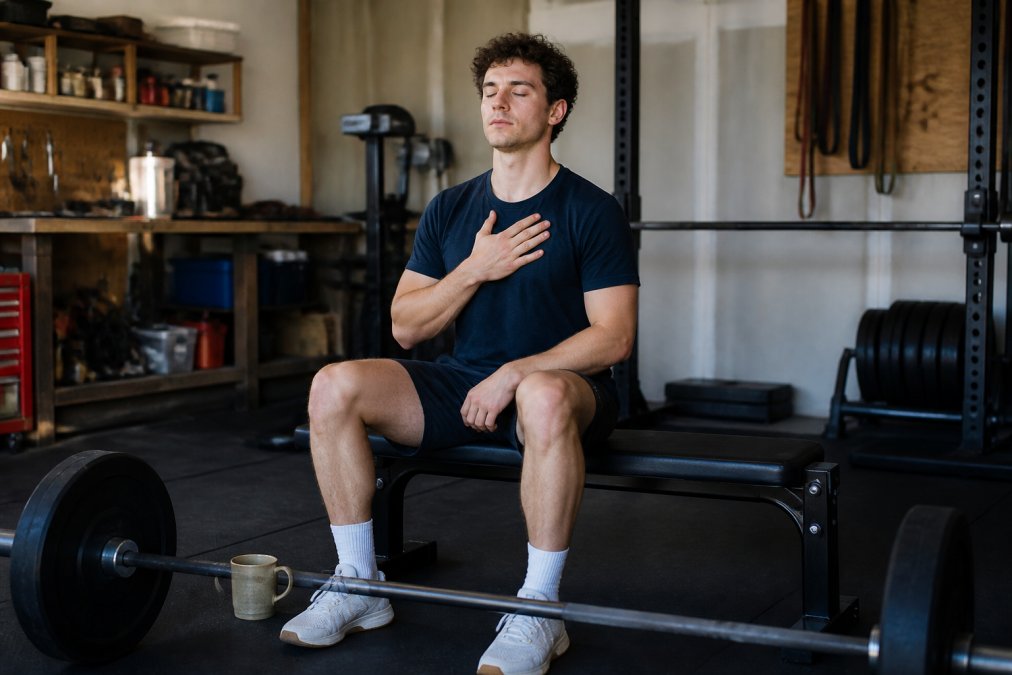
Breathe Through the Pre-Set Nerves
Breathing techniques for stimulant-induced anxiety work because they trigger your parasympathetic nervous system. That's the branch that calms you down.
Try this before your first working set:
- Inhale through your nose for 4 seconds
- Hold for 4 seconds
- Exhale through your mouth for 6 seconds
- Repeat 5 times
Hydration, Electrolytes, and the Jittery Crash
Caffeine is a mild diuretic, so it pushes fluid out of your body. Training makes you sweat. Together, they drain your electrolyte balance.
| Problem | Cause | Fix |
|---|---|---|
| Shaky hands | Low magnesium or caffeine spike | Add electrolytes, cut dose |
| Racing heart | Dehydration plus stimulant | Drink water with sodium |
| Mid-session crash | Blood sugar dip | Eat carbs before training |
| Headache after | Fluid loss | 500 ml water per hour |
Clean Pre Workout Coffee Alternative: What to Look For
A clean pre workout coffee alternative gives you caffeine without the additives that make jitters worse. The label tells you almost everything.
Look for these on the bag or box:
- Single-origin or clearly stated beans
- Roast date printed, not just a best-by date
- No added sugar or artificial sweeteners
- Caffeine amount stated per serving
- No proprietary blends hiding stimulants
Recovery, Tolerance, and the Day After
Caffeine's half-life means yesterday's cup is still in your system this morning. That's why tolerance creeps up quietly.
To reduce caffeine tolerance:
- Take 2-3 caffeine-free days each week
- Stop all caffeine 8-10 hours before bed
- Swap one daily cup for decaf or herbal tea
- Lower your dose by 25% every few weeks
Conclusion
Jitters during strength training come from too much caffeine, bad timing, and dehydration, not from coffee itself. Fix the dose, pair it with L-theanine, breathe through the nerves, and keep your electrolytes up.
Find your fuel and train steady.
Frequently Asked Questions
How do I counteract jitteriness from coffee before a workout?
Lower your dose first, then slow the absorption. Cut your pre-training caffeine to roughly 1 to 2 mg per pound of body weight instead of the 400 mg many lifters take. Drink it 45 to 60 minutes before your first working set so the peak passes before you load the bar. Pairing caffeine with L-theanine (about 100 to 200 mg) smooths the edge for many people. Slow breathing between sets also pulls your heart rate down. If you still feel wired, switch to a lighter roast or a decaf blend for afternoon sessions.
Is 400 mg of caffeine a lot before a workout?
For most adults, 400 mg per day is the general ceiling cited by health authorities, not a target to hit before training. A single 400 mg dose before lifting pushes many people past their personal tolerance, especially if they weigh under 150 pounds or drink coffee only occasionally. That is when heart rate climbs, hands shake, and focus narrows into anxiety. Start closer to 100 to 200 mg for a 150-pound lifter and adjust up only if you feel steady, not just stimulated.
What are the best clean pre workout coffee alternatives?
Look for freshly roasted coffee or tea with no added sugar, no artificial sweeteners, and a caffeine content you can read on the label. Single-origin options and medium roasts tend to deliver a smoother curve than dark, over-roasted beans. If you train in the evening, a Swiss Water Process decaf gives you the ritual without the stimulant. Herbal blends like rooibos or hibiscus are fully caffeine free and work well as a pre-session warm drink when you want the routine, not the buzz.
Why does coffee make me jittery during exercise but not at my desk?
Exercise amplifies caffeine's effects. Lifting raises heart rate, blood pressure, and cortisol on its own, and caffeine adds to all three by blocking adenosine receptors and triggering adrenaline release. At your desk, that same dose has nowhere to go. Under a heavy squat, it shows up as shaking hands, a racing pulse, and a narrow, anxious focus. Hydration and electrolyte loss during training make it worse. Drinking your coffee earlier and sipping water through the session usually settles it.