


Table of Contents
- Coffee vs Pre-Workout: How They Compare at a Glance
- Caffeine Content: What You Actually Get Per Serving
- Caffeine and Muscle Protein Synthesis: What the Evidence Says
- Recovery-Specific Ingredients: Coffee vs Pre-Workout Formulas
- Is Coffee a Clean Pre-Workout Coffee Alternative for Recovery Days?
- Timing, Dosage, and Individual Metabolic Response
- Side Effects, Jitters, and Long-Term Hormonal Impact
- Conclusion: Choosing Your Recovery Fuel
- Frequently Asked Questions
Last Updated: September 28, 2026
Coffee vs Pre-Workout: How They Compare at a Glance
Coffee vs pre-workout supplements for muscle recovery comes down to one question: do you want caffeine alone, or caffeine plus a formula built for repair? Coffee delivers clean caffeine and antioxidants. Most pre-workout powders deliver caffeine plus ingredients aimed at blood flow and endurance. At Ed In Your Head, we roast coffee the day it ships for athletes and gamers who want steady energy without the crash.
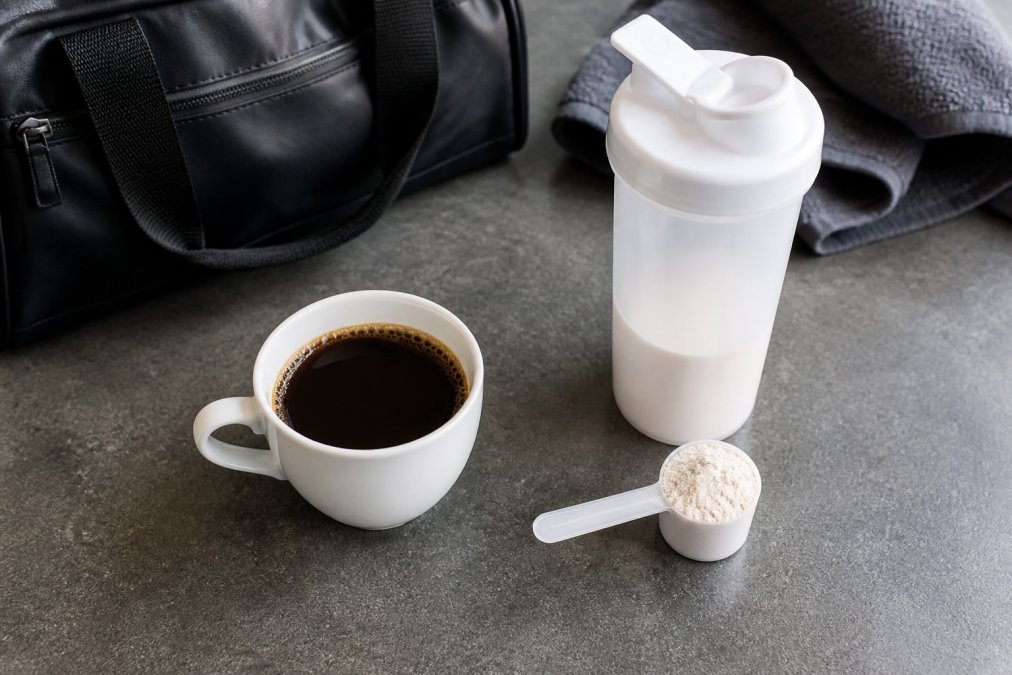
Here is the short version. Coffee is the better base for recovery days because it avoids the stimulant blends that keep you wired after training. Pre-workout wins only when a formula contains recovery-specific ingredients coffee does not have.
| Factor | Coffee | Pre-Workout |
|---|---|---|
| Caffeine source | Natural, brewed | Often caffeine anhydrous |
| Extra ingredients | Antioxidants, trace minerals | Beta-alanine, citrulline, taurine |
| Crash risk | Lower | Higher with high-stim formulas |
| Cost per serving | Lower | Higher |
| Best for | Recovery days, steady focus | Max-intensity sessions |
Caffeine Content: What You Actually Get Per Serving
Caffeine content is where the comparison gets messy, because a scoop of powder is not a cup of coffee. Most pre-workout labels disclose caffeine per scoop, often in the 150-300 mg range. A standard 8 oz cup of brewed coffee typically lands between 95-165 mg, depending on roast and brew strength.
Caffeine and Muscle Protein Synthesis: What the Evidence Says
Caffeine and muscle protein synthesis are not directly linked in the way supplement marketing suggests. Caffeine is an ergogenic aid: it blocks adenosine receptors, which reduces perceived effort and can raise workout intensity. Muscle protein synthesis is driven mainly by protein intake and resistance training, not by caffeine itself.
Recovery-Specific Ingredients: Coffee vs Pre-Workout Formulas
Recovery-specific ingredients are where pre-workout formulas pull ahead on paper, and where you need to read labels carefully. The key distinction most guides blur is that a pre-workout contains two separate categories of compounds: stimulants (caffeine, theobromine, yohimbine) and non-stimulant recovery or performance aids. Only the second category has anything to do with muscle repair.
- L-citrulline / citrulline malate, converted in the kidneys to L-arginine, which raises nitric oxide and improves blood flow to working muscle. Typical studied doses are 6-8 g of citrulline malate or 3-6 g of pure L-citrulline. The blood-flow effect is the closest thing in a pre-workout to a genuine recovery mechanism, because perfusion delivers amino acids and clears metabolic waste.
- Beta-alanine, buffers intramuscular acidity by raising carnosine stores. It is not a recovery ingredient in the acute sense; it is a chronic loading ingredient that takes 2-4 weeks of daily 3.2-6.4 g dosing to matter. If your pre-workout has 1.6 g, you are getting half a dose.
- Betaine (trimethylglycine), studied at 2.5 g per day for strength and body-composition support. Weak but real evidence.
- Taurine, 1-2 g is common; supports hydration and may reduce muscle damage markers, though the human evidence is modest.
- Electrolytes (sodium, potassium, magnesium), relevant only if you are training long or sweating heavily. A 30-minute lift does not deplete you enough to matter.
Here is the practical split:
- Choose pre-workout if you want citrulline, beta-alanine, and a muscle pump in one scoop, and you are willing to verify the doses.
- Choose coffee if you want a stimulant base with functional ingredients and no proprietary blend. Our Coffee with Mushrooms Medium Roast is infused with Lion's Mane, Cordyceps, and Reishi mushrooms, a combination many athletes use for focus and endurance support. The dark roast version offers the same infusion with a bolder profile.
- Stack deliberately if you want both: a plain cup of coffee for caffeine plus a stim-free pump formula for citrulline avoids doubling caffeine while still getting the blood-flow benefit.
- Avoid doubling up on two full-stim products within the same window unless you are tracking total caffeine.
Is Coffee a Clean Pre-Workout Coffee Alternative for Recovery Days?
A clean pre-workout coffee alternative is simply brewed coffee used in place of a powdered stimulant blend. It works because coffee gives you caffeine, fluid, and antioxidants without artificial sweeteners, dyes, or the sugar load in many energy drinks.


On recovery days, brew a slightly larger cup and drink half before your session and half during. You get a steadier caffeine curve than one large dose, and you avoid the late-afternoon jitters that wreck sleep.
Timing, Dosage, and Individual Metabolic Response
Timing and dosage depend on your own metabolic response, not a universal number, and this is the single biggest gap in most coffee-vs-pre-workout comparisons. Caffeine is metabolized primarily by the CYP1A2 enzyme in the liver, and common genetic variants in the CYP1A2 gene split people into roughly fast, intermediate, and slow metabolizers. Fast metabolizers clear caffeine quickly and often tolerate a late-afternoon dose without sleep disruption.
- Likely fast metabolizer: you can drink coffee after dinner and still fall asleep within 30 minutes; you rarely feel jittery at moderate doses.
- Likely slow metabolizer: a single afternoon cup keeps you awake; you feel anxious or wired at doses others shrug off; you notice a crash 3-4 hours after a pre-workout scoop.
A workable approach that respects that split:
- Dose: 1-2 cups of coffee, or one scoop of pre-workout, about 30-45 minutes before training. General guidance from sports nutrition bodies puts ergogenic caffeine dosing in the 3-6 mg per kg of body weight range, which for a 150 lb athlete is roughly 200-400 mg, well above a single 8 oz cup.
- Cutoff: stop caffeine 8-10 hours before bed if you sleep poorly. Slow metabolizers should push that to 12 hours.
- Tolerance: cycle down every few weeks so the same dose keeps working. Adenosine receptor upregulation is real, and it is why the same scoop stops hitting after a month of daily use.
- Titration: if you are switching from a 300 mg pre-workout to a single cup of coffee, expect the first week to feel weaker. That is tolerance resetting, not the coffee failing.
The recovery window is mostly a sleep window. Any caffeine habit that costs you deep sleep is costing you muscle repair, no matter how good the workout felt, and your CYP1A2 phenotype determines how much of that window you are actually protecting.
Side Effects, Jitters, and Long-Term Hormonal Impact
Side effects and long-term hormonal impact are the strongest argument for coffee over high-stim powders. Jitteriness, racing heart, and anxiety are dose-dependent and show up more often with caffeine anhydrous, which hits faster than brewed coffee. Coffee's caffeine arrives with fluid and other compounds, so the curve is gentler.
The recovery window is mostly a sleep window. Any caffeine habit that costs you deep sleep is costing you muscle repair, no matter how good the workout felt.
Conclusion: Choosing Your Recovery Fuel
The choice is less about which is stronger and more about what your day needs. Pre-workout earns its place on max-effort days when you want citrulline, beta-alanine, and a pump in one scoop. Coffee earns its place on recovery days, easy sessions, and long focus blocks where a steady curve beats a spike.
FIND YOUR FUEL.
Frequently Asked Questions
Is coffee better than pre-workout before the gym?
It depends on what you want from the session. Coffee delivers caffeine plus chlorogenic acids and small amounts of magnesium and potassium, which support steady energy and blood flow without the added sugars or proprietary blends found in many pre-workout tubs. Pre-workout formulas often stack caffeine anhydrous with beta-alanine, citrulline, and nitric oxide boosters for a bigger muscle pump and longer endurance capacity. For pure recovery-focused training days, plain coffee is the simpler, cleaner option.
Does caffeine help with muscle recovery after exercise?
Caffeine is not a recovery nutrient, but it can indirectly support recovery. Research on caffeine and muscle protein synthesis suggests caffeine may influence how efficiently your body uses protein after training, though the effect varies by individual metabolic response and caffeine tolerance. What caffeine reliably does is reduce perceived effort and delay fatigue, which lets you train at a higher workout intensity. Pair it with protein and carbohydrates inside the recovery window for glycogen replenishment.
What are the side effects of pre-workout supplements compared to coffee?
Pre-workout formulas frequently combine 200 to 300 mg of caffeine anhydrous with beta-alanine, taurine, and artificial sweeteners, which can trigger jitteriness, tingling, and a hard crash two to three hours later. Coffee's caffeine arrives alongside water and natural compounds, and its half-life of roughly five hours means a slower, steadier curve for most people. If you are sensitive to central nervous system stimulation, a medium-roast cup is easier to manage than a scoop of high-stimulant powder.
Can coffee act as a clean pre-workout coffee alternative without added sugar?
Yes. Black coffee contains zero added sugar and no artificial colors or sweeteners, making it a genuinely clean pre workout coffee alternative. The catch is quality and dose. A 2 oz bag of freshly roasted beans brewed at home gives you control over strength, and options like Breakfast Blend + (Extra Caffeine) or Max Caf Blend raise the caffeine ceiling without the sugar crash. Skip flavored syrups and you keep the ingredient list to one item.
How does the sugar content in pre-workout affect post-workout recovery?
Many pre-workout powders and ready-to-drink energy products carry 10 to 30 grams of sugar or sugar alcohols per serving. That spike raises blood glucose fast, then drops it, which can leave you flat right when your recovery window opens. Elevated cortisol from a crash also works against muscle repair. Coffee with no added sugar keeps blood sugar stable, so your post-workout meal does the recovery work instead of fighting a glucose swing.