


Table of Contents
- Does Roasting Burn Off Caffeine? The Short Answer
- Light Roast vs Dark Roast: Caffeine Content by Weight vs Volume
- Why Bean Density Changes Caffeine Concentration
- The Science: Chemical Stability and Thermal Degradation
- How to Brew Fresh Coffee for Peak Performance
- Caffeine Per Serving vs Caffeine Per Bean: What Matters
- Conclusion: Choose Your Roast for Your Game
- Frequently Asked Questions
Last Updated: September 6, 2026
Does Roasting Burn Off Caffeine? The Short Answer
No, roasting does not burn off caffeine. The roasting impact on caffeine is far smaller than most coffee drinkers assume, and the idea that dark roasts are weaker is one of the most persistent myths in coffee. Caffeine is a remarkably stable alkaloid, and the temperatures used in commercial roasting, typically between 370°F and 540°F, fall well short of the heat required to break it down (PubMed).
The confusion starts with how we measure coffee. At Ed In Your Head, we roast every order the day it ships, and we know gamers and athletes are trying to dial in their energy. The real story is about density, weight, and volume, not heat destroying the caffeine molecule. The roasting impact on caffeine content is minimal, but the roasting impact on bean structure is dramatic.
So if you are choosing between a light roast and a dark roast for your pre-game ritual, the science says something surprising. A dark roast bean actually contains slightly less caffeine by weight than its light roast counterpart, but a scoop of dark roast has more caffeine than a scoop of light roast. Below, we will break down exactly why that happens and what it means for your brew.
Light Roast vs Dark Roast: Caffeine Content by Weight vs Volume
The most direct answer is that light roast coffee has marginally more caffeine per bean than dark roast. During roasting, beans lose mass through moisture loss and the breakdown of organic compounds, but caffeine itself remains largely intact. This means the caffeine concentration per gram of roasted coffee is slightly higher in a light roast because it has lost less total mass.
However, most people do not brew by weight at home. They use a scoop. When you measure by volume, the dynamic flips. Dark roast beans expand more during roasting, making them larger and less dense. A tablespoon of dark roast contains fewer beans than a tablespoon of light roast, which means you are actually packing more coffee, and therefore more caffeine, into your scoop with a dark roast.
| Measurement Method | Light Roast | Dark Roast | Caffeine Winner |
|---|---|---|---|
| Per Bean | Higher caffeine concentration | Slightly lower concentration | Light roast |
| Per Gram (weight) | Higher caffeine content | Lower caffeine content | Light roast |
| Per Scoop (volume) | Fewer beans fit | More ground coffee fits | Dark roast |
| Per Serving (typical brew) | Comparable | Comparable | Roughly equal |
Measuring Coffee by Weight vs Volume: The Real Culprit
Measuring coffee by weight vs volume explains nearly all the conflicting advice you will read about roast levels and caffeine. If a barista weighs 20 grams of light roast and 20 grams of dark roast, the light roast wins on caffeine every time. But if you scoop both, the dark roast wins because its expanded, porous structure lets you fit more ground coffee into the same space.
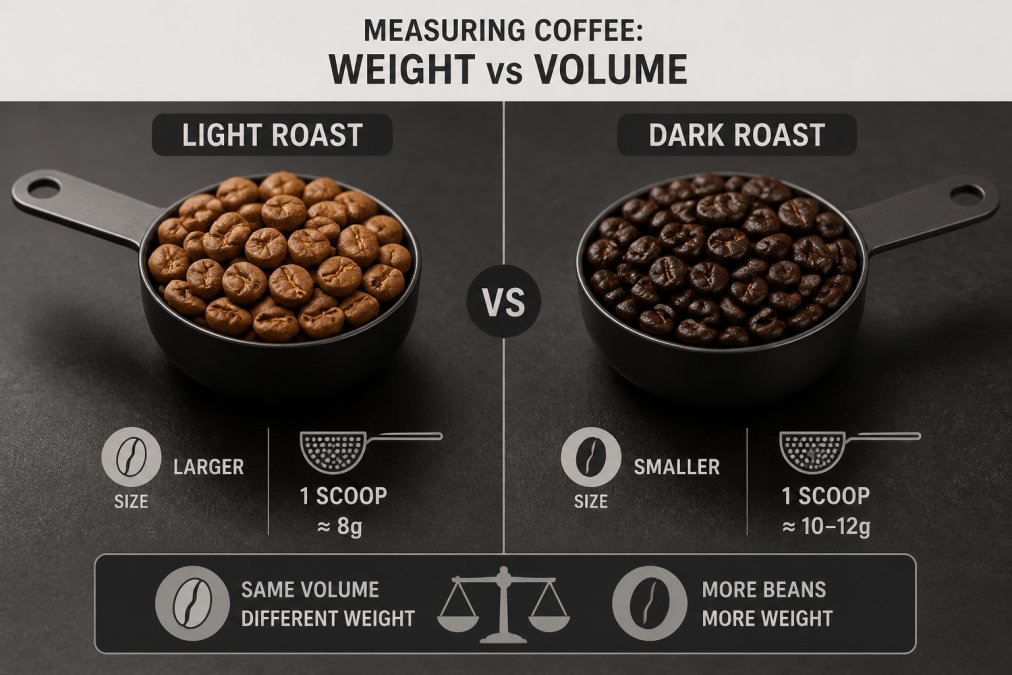
For anyone serious about consistent energy, a kitchen scale is the single best upgrade you can make. Weighing your coffee eliminates the mass vs volume confusion entirely and gives you repeatable results every morning. This matters more than your roast choice if your goal is predicting how a cup will hit before a long gaming session.
Why Bean Density Changes Caffeine Concentration
Roasting transforms a dense, green coffee seed into a brittle, aromatic bean through expansion and moisture loss. As the bean heats, internal water turns to steam and forces the structure to swell. This bean expansion increases the overall size while reducing the density, which directly changes how caffeine is distributed in your brew.
The key insight is that caffeine is concentrated in the bean's cellular structure before roasting. Since roasting does not destroy caffeine, the total amount stays roughly constant while the bean gets bigger and lighter. This is why dark roasts taste bolder and more intense, yet contain less caffeine per gram than their lighter counterparts.
What most guides miss is that bean density also affects extraction. A dense light roast requires more heat and a finer grind to extract fully, while a porous dark roast surrenders its solubles more easily. The roasting impact on caffeine extraction is therefore indirect, it changes the physical structure that water must penetrate, not the caffeine itself.
The Science: Chemical Stability and Thermal Degradation
Caffeine (C₈H₁₀N₄O₂) is a purine alkaloid with a molecular structure that makes it exceptionally resistant to heat. Its melting point is 455°F (235°C), and it does not begin to sublimate, transition directly from a solid to a gas, until it reaches roughly 352°F (178°C) at normal atmospheric pressure (pubchem.ncbi.nlm.nih.gov). However, even at that sublimation point, the process is slow and requires sustained exposure. Commercial coffee roasters typically operate between 370°F and 540°F (188°C to 282°C), but the bean's internal temperature rarely exceeds 480°F (249°C) for more than a few minutes during the final stages of a dark roast. This brief window is insufficient to cause significant caffeine loss.
What actually happens inside the bean is a series of competing chemical transformations. The most relevant is the Maillard reaction, which begins around 300°F (149°C). This reaction between amino acids and reducing sugars creates hundreds of flavor compounds, including pyrazines, thiazoles, and furans, the molecules responsible for the nutty, toasted, and caramelized notes in your cup. Simultaneously, chlorogenic acids, which are abundant in green coffee and contribute to its astringent, vegetal character, begin to degrade. By the time a bean reaches a City+ or Full City roast (around 425°F to 445°F), a significant portion of these acids has broken down into quinic acid and caffeic acid, which are less bitter and more palatable.
Caffeine, however, does not participate in these reactions. It is not a reactant in the Maillard pathway, nor does it degrade into other compounds at roasting temperatures. The only measurable change is a slight concentration increase relative to the bean's total mass, because the bean loses 12% to 20% of its weight as water and volatile organic compounds evaporate. If a green bean starts at 1.2% caffeine by weight and loses 15% of its mass, the roasted bean will measure closer to 1.4% caffeine by weight, not because new caffeine was created, but because the denominator shrank.
A common misconception is that the 'burned' or 'smoky' flavor of a dark roast indicates destroyed caffeine. That flavor comes from the pyrolysis of sugars and cellulose at temperatures above 440°F (227°C), which produces phenolic compounds like guaiacol and creosol. These compounds are potent flavorants but have zero stimulant effect. The bitterness you taste in a dark roast is primarily from these phenolics and from the prolonged breakdown of chlorogenic acids, not from free caffeine molecules.
For a practical comparison, consider that the caffeine content of a roasted bean varies by less than 5% across the entire spectrum from a light Cinnamon roast to a dark French roast. In contrast, the flavor profile shifts dramatically, dark roasts lose up to 90% of their chlorogenic acids and develop entirely new aromatic compounds. The roasting impact on caffeine is therefore a rounding error compared to the roasting impact on flavor chemistry.
How to Brew Fresh Coffee for Peak Performance
The single most underappreciated variable in caffeine delivery is the interaction between grind size and roast level. Most guides treat grind as a flavor tool, but it is equally a caffeine extraction tool. Because dark roasts are more porous and soluble, they surrender their solubles, including caffeine, more readily. Light roasts, with their denser cellular structure, require more surface area to achieve the same extraction yield.
Here is the practical rule: for a light roast, grind finer than you would for a dark roast using the same brew method. A fine grind (similar to table salt) increases the surface area exposed to water, allowing the water to penetrate the dense bean structure and pull out the caffeine. For a dark roast, a coarser grind (similar to sea salt) is sufficient because the expanded, brittle structure lets water flow through easily. If you use a fine grind on a dark roast, you risk over-extraction, which pulls out bitter compounds that mask the flavor, but the caffeine yield will be similar to a properly ground light roast.
This is the gap most articles miss: they compare roasts at a single grind setting, which biases the results. If you brew a light roast and a dark roast with the same grind, the dark roast will extract more caffeine because it is more soluble. But if you adjust the grind to match the roast, the caffeine yields converge. The roasting impact on caffeine is therefore mediated by your grinder, not just your scale.
A second variable that competitors overlook is water temperature. The Specialty Coffee Association recommends brewing between 195°F and 205°F (91°C to 96°C) (sca.coffee). At the lower end of this range, extraction slows, and a dense light roast may under-deliver on caffeine. At the higher end, a dark roast can over-extract, producing bitter flavors. For a consistent caffeine dose, aim for 200°F (93°C) as a middle ground, and adjust your grind rather than your temperature to fine-tune extraction.
Freshness also plays a direct role in caffeine yield. Coffee beans release carbon dioxide for up to two weeks after roasting. This gas creates a barrier that repels water, slowing extraction. Beans roasted three days ago will extract less caffeine than beans roasted ten days ago, even at the same grind size and ratio. This is why 'resting' coffee for 4 to 7 days after roasting is a common practice among specialty roasters, it allows the degassing to slow down, improving extraction efficiency. If you are brewing beans that arrived yesterday, you may need to grind slightly finer or extend your brew time by 10 to 15 seconds to compensate.
For a concrete starting point, use a 1:16 coffee-to-water ratio by weight (e.g., 30 grams of coffee to 480 grams of water). For a light roast, set your grinder to a medium-fine setting (around 600 to 800 microns). For a dark roast, move to a medium-coarse setting (around 800 to 1000 microns). Brew for 3 to 4 minutes using a pour-over or French press. This combination will typically extract 18% to 22% of the coffee's solubles, which is the optimal range for both flavor and caffeine delivery.
Caffeine Per Serving vs Caffeine Per Bean: What Matters
The distinction between caffeine per serving and caffeine per bean resolves the light versus dark debate for good. A single dark roast bean has marginally less caffeine than a single light roast bean, but you never drink one bean. You drink a serving, and how much coffee you use to make that serving dictates your total caffeine intake.
For practical purposes, your roast choice has almost no effect on the caffeine in your mug. A typical serving of either roast lands in a similar range because the differences per bean are tiny and the brewing variables dominate. What actually matters is your coffee-to-water ratio, your grind size, and whether your beans are fresh enough to extract properly.
This is where choosing the right product matters. If you want a guaranteed higher caffeine experience without guessing, look for blends specifically designed for it. Ed In Your Head offers a Max Caf Blend that combines Tanzania and India Robusta beans, a variety known for roughly double the caffeine of Arabica, giving you a reliable boost without the volume guesswork.

Conclusion: Choose Your Roast for Your Game
The roasting impact on caffeine is real but minor, and it is almost always outweighed by how you measure, grind, and brew your coffee. Light roasts hold a slight edge per bean, dark roasts win per scoop, and both deliver comparable caffeine per serving. The variables that truly control your energy are freshness, grind consistency, and bean variety.
If your goal is peak mental performance without the jitters or crash of sugary energy drinks, the cleanest path is high-quality, fresh-roasted coffee with a known caffeine profile. Ed In Your Head roasts every order the day it ships, so your beans arrive at peak flavor and extraction potential. Whether you prefer the smooth medium of the Breakfast Blend + or the deep intensity of the French Roast, you get clean caffeine designed for focus.

Stop guessing and start measuring. Pick a roast that fits your taste, weigh your coffee, and brew it fresh. Your next session deserves better than stale beans and conflicting internet advice.
Frequently Asked Questions
Does roasting coffee affect caffeine content?
Roasting itself does not significantly destroy caffeine molecules. Caffeine is thermally stable up to about 460°F, well above typical roasting temperatures. The real difference in caffeine between light and dark roasts comes down to measuring method and bean density, not chemical breakdown from heat.
Is there more caffeine in light roast or dark roast coffee?
By weight, light roast beans contain slightly more caffeine because they are denser and lose less mass during roasting. By volume, dark roast beans contain more caffeine because they expand and are less dense, so a scoop holds fewer beans. For consistent caffeine, measure your coffee by weight, not volume.
How does measuring coffee by scoop versus weight affect caffeine intake?
A scoop of dark roast contains less coffee by weight than a scoop of light roast because dark beans are less dense. This means your caffeine intake changes based on how you measure. Using a digital scale ensures you get the same caffeine dose every time, regardless of roast level.
Choosing between roasts does not have to be a gamble on your energy. At Ed In Your Head, our athletic trainer-owned roastery delivers fresh-roasted coffee with zero added sugar and no crash, crafted for gamers and athletes who need steady focus. Find your fuel with a blend built for performance and taste the difference freshness makes.