


Table of Contents
- What Makes a Clean Pre Workout Coffee Alternative?
- Natural Pre Workout Ingredients That Actually Deliver
- Benefits of Coffee for Athletic Performance
- How to Avoid Pre Workout Jitters Without Ditching Caffeine
- 7 Clean Pre Workout Coffee Alternatives Ranked
- How to Time Your Pre Workout Nutrition for Best Results
- Gut Health, Digestion, and Post-Workout Recovery Synergy
- Conclusion
Last Updated: August 19, 2026
What Makes a Clean Pre Workout Coffee Alternative?
A clean pre workout coffee alternative delivers performance-enhancing energy, focus, or endurance without synthetic stimulants, artificial sweeteners, or excessive caffeine doses. Clean energy means sustained release without the crash, ruling out most conventional energy drinks loaded with artificial colors, sugar spikes, and proprietary blends.
A genuinely clean pre workout source should be transparent about ingredients, deliver cognitive and physical endurance benefits, and leave you feeling finished rather than wrecked after your session.
What qualifies as "clean" comes down to four criteria:
- Natural stimulants or stimulant-free compounds with documented performance benefits
- No added sugar or artificial sweeteners that spike blood glucose and crash energy
- Bioavailability, the compounds need to actually absorb and work, not just appear on a label
- Digestive tolerance, clean pre workout fuel shouldn't cause gut distress mid-session
Natural Pre Workout Ingredients That Actually Deliver
The most effective natural pre workout ingredients work through specific physiological mechanisms: improving blood flow, supporting mitochondrial energy production, buffering fatigue, or modulating the stress response.
Adaptogens: Mushrooms, Ashwagandha, and Rhodiola
Adaptogens are plants and fungi that help the body resist physical and psychological stress, translating to more consistent performance under pressure and faster recovery.
Lion's Mane is traditionally associated with cognitive function and mental clarity, complementing caffeine's alertness benefits without adding stimulant load.
Cordyceps has a long history for supporting stamina and vitality, making it popular with endurance athletes.
Rhodiola rosea is one of the more studied adaptogens for exercise performance. According to examine.com's research summary on Rhodiola, it shows meaningful effects on reducing perceived exertion and mental fatigue during prolonged effort.
Ashwagandha lowers cortisol response, which matters if you're training hard or managing accumulated stress.
Nitrate-Rich Foods for Blood Flow and Vasodilation
Dietary nitrates convert to nitric oxide in the body, triggering vasodilation that improves blood flow to working muscles. Beet juice, spinach, arugula, and celery are high in dietary nitrates. Consuming them 90-120 minutes before training improves oxygen delivery and workout intensity at the same perceived effort.
Whole food sources outperform many synthetic pre workout products due to superior bioavailability and ingredient transparency.
Electrolytes and Hydration for Sustained Output
Dehydration affects cognitive function, reaction time, and muscular endurance. Electrolytes, sodium, potassium, magnesium, and calcium, regulate fluid balance and nerve signaling.
Arriving at your workout already hydrated beats any supplement. A glass of water with sea salt and lemon is an effective, caffeine-free electrolyte primer. For longer sessions, coconut water provides potassium and natural carbohydrates without artificial ingredients.
Benefits of Coffee for Athletic Performance
Coffee is arguably the most well-studied natural performance enhancer available. Caffeine improves endurance, reduces perceived exertion, enhances cognitive function, and has a mild thermogenic effect.

According to the International Society of Sports Nutrition's position stand on caffeine, caffeine is one of the most effective and safe ergogenic aids available across endurance, strength, and cognitive performance tasks.
Specialty coffee delivers a cleaner caffeine profile than commodity coffee, less acidity, more consistent caffeine content, and better flavor. The pre-workout crash is almost always a function of poor quality, excessive dose, or drinking on an empty stomach rather than anything inherent to coffee itself.
Lighter roasts preserve more natural compounds that contribute to smooth, sustained energy. Darker roasts trade complexity for a bolder, lower-acid cup.
How to Avoid Pre Workout Jitters Without Ditching Caffeine
Jitters from caffeine signal that the dose is too high, the source is too low quality, or the timing is off. The fix isn't eliminating caffeine, it's managing it better.
Pairing caffeine with L-theanine, an amino acid found naturally in green tea, promotes calm alertness and counteracts the anxious edge that pure caffeine can produce. Matcha contains both compounds naturally, making it a popular clean pre workout option.
Other practical strategies:
- Eat before you dose. Caffeine on an empty stomach hits harder and faster, increasing jitters and GI distress.
- Lower the dose. Many people perform best at moderate intake rather than maximum.
- Choose high-quality sources. Fresh-roasted specialty coffee produces a smoother energy curve than stale commodity coffee.
- Time it right. Consuming caffeine 30-45 minutes before training gives it time to peak without front-loading the stimulant effect.
7 Clean Pre Workout Coffee Alternatives Ranked
Here are seven options ranked by versatility, performance benefit, and accessibility. Each clears the clean pre workout bar: no artificial ingredients, no added sugar, no synthetic stimulants.
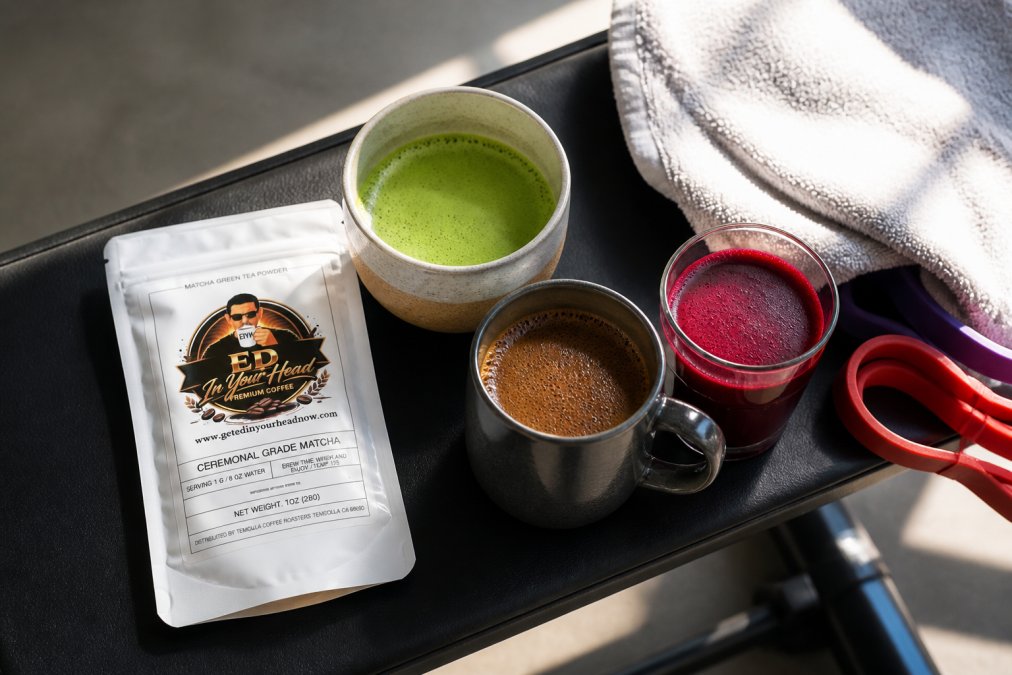
Quick Picks:
- Best Overall: Specialty coffee with functional mushrooms
- Best for Jitter-Free Focus: Matcha
- Best Low-Stimulant Option: Hojicha
- Best Thermogenic Warmup: Masala Chai
- Best for Maximum Output: High-caffeine specialty coffee blends
- Best Caffeine-Free Performance: Beet juice and nitrate-rich foods
- Best Budget Option: DIY pre workout recipes
1. Specialty Coffee with Functional Mushrooms
This is the top pick for athletes and gamers who want clean caffeine plus cognitive support in a single cup. The combination of specialty-grade coffee with Lion's Mane, Cordyceps, and Reishi mushrooms covers multiple performance angles: caffeine for alertness and endurance, Lion's Mane for focus, Cordyceps for stamina, and Reishi for stress balance.
Ed In Your Head's Coffee with Mushrooms Dark Roast and Coffee with Mushrooms Medium Roast are specialty-grade coffee infused with all three mushrooms, roasted fresh the day your order ships. The Instant Coffee with Mushroom version adds convenience for travel or recovery.


Pros: Clean caffeine plus adaptogen support, no added sugar, multiple roast options, fresh-roasted Cons: Contains caffeine, not suitable for those avoiding stimulants entirely
2. Matcha for Jitter-Free Focus
Matcha is the best caffeine-containing coffee alternative for people sensitive to jitters. The L-theanine naturally present modulates caffeine's stimulant effect, producing calm, sustained alertness without anxiety. The caffeine content is lower than coffee, making it ideal for afternoon sessions.
Ed In Your Head's Matcha is crafted for traditional preparation, starting at $19.99.
Pros: Naturally jitter-free, L-theanine plus caffeine synergy, rich in micronutrients, lower caffeine than coffee Cons: Lower workout intensity stimulus than coffee for high-output sessions
3. Hojicha for Low-Stimulant Clean Energy
Hojicha is a roasted green tea with high-heat processing that converts much of its caffeine into other compounds. The result is low-stimulant tea with a warm, toasted flavor and grounding effect.
For athletes who train in the evening or need light focus without overstimulation, hojicha fills a gap that neither coffee nor matcha can. Ed In Your Head's Hojicha is stone-milled from carefully selected tea leaves, at $19.99.
Pros: Very low caffeine, calming and grounding, excellent for evening sessions Cons: Minimal performance enhancement for high-intensity training
4. Masala Chai for Thermogenic Warmup
Masala chai brings thermogenesis to the pre workout conversation. The spice blend, black pepper, ginger, cardamom, cinnamon, and cloves, raises core body temperature slightly and primes the body for exertion. Ginger improves circulation and reduces muscle soreness.
The caffeine content from black tea is moderate, making chai a middle-ground option between matcha and coffee. Ed In Your Head's Masala Chai is bold, spicy, and full-bodied, available at $19.99.
Pros: Thermogenic spice blend, moderate caffeine, excellent for cold-weather warmup, anti-inflammatory compounds Cons: Traditionally served with milk and sugar; keep it clean by using unsweetened plant milk
5. High-Caffeine Specialty Coffee Blends
For high-intensity training or competition days, a purpose-built high-caffeine specialty blend outperforms any supplement powder. The key is choosing a blend where extra caffeine comes from higher-caffeine bean varieties like Robusta rather than synthetic additions.
Ed In Your Head's Max Caf Blend combines Tanzania and India Robusta for high-caffeine, natural option at $25.99. The Breakfast Blend + adds Robusta to a medium roast for a step up without going full intensity.
Pros: Maximum natural caffeine, no synthetic additives, specialty-grade quality, fresh-roasted Cons: Not appropriate for caffeine-sensitive individuals or evening sessions
6. Beet Juice and Nitrate-Rich Whole Foods
The only fully caffeine-free performance option on this list. Beet juice delivers concentrated dietary nitrates that convert to nitric oxide, driving vasodilation and improved blood flow. According to research published in the Journal of Applied Physiology, dietary nitrate supplementation consistently improves exercise economy and time-to-exhaustion in endurance tasks.
For athletes who avoid all stimulants, beet juice is the most evidence-backed caffeine-free pre workout option. Pair it with spinach or arugula in a pre-workout smoothie to stack the nitrate dose.
Pros: Fully caffeine-free, evidence-backed vasodilation benefit, whole food source, budget-friendly Cons: Timing-dependent (needs 90-120 minutes to peak), acquired taste, limited cognitive benefit
7. Budget-Friendly DIY Pre Workout Recipes
A DIY clean pre workout recipe costs a fraction of any commercial product and gives complete control over every ingredient.
DIY Beet-Matcha Pre Workout Blend:
1 tsp ceremonial matcha 4 oz cold-pressed beet juice 1 tsp raw honey (optional) Pinch of sea salt 4 oz cold water or coconut water
Whisk matcha in 2 oz of 175°F water first, then combine with remaining cold ingredients over ice. Consume 30-45 minutes before training.
This recipe stacks matcha's L-theanine-caffeine synergy with beet juice's nitrate-driven vasodilation and electrolytes. Total cost per serving runs well under $2.
Pros: Full ingredient transparency, highly customizable, lowest cost per serving Cons: Requires preparation time, ingredient sourcing takes initial effort
| Option | Caffeine | Key Benefit | Best For |
|---|---|---|---|
| Mushroom Coffee | Moderate-High | Focus + adaptogen support | Athletes and gamers |
| Matcha | Low-Moderate | Jitter-free, L-theanine synergy | Caffeine-sensitive users |
| Hojicha | Very Low | Calming, low stimulant | Evening sessions |
| Masala Chai | Moderate | Thermogenic warmup | Cold-weather training |
| High-Caf Coffee Blend | High | Maximum natural caffeine | Competition/high-output days |
| Beet Juice | None | Vasodilation, blood flow | Stimulant-free athletes |
| DIY Blend | Variable | Customizable, budget-friendly | Budget-conscious users |
How to Time Your Pre Workout Nutrition for Best Results
Timing your clean pre workout nutrition correctly often matters as much as what you consume.
General timing guidelines:
- Caffeine-based options (coffee, matcha, chai): Peak effect occurs 30-60 minutes after consumption. Consume 30-45 minutes before training.
- Nitrate-rich foods and beet juice: Nitric oxide conversion takes longer. Target 90-120 minutes before exercise for maximum vasodilation benefit.
- Adaptogens: Most work best with consistent daily use rather than acute dosing.
- Electrolytes and hydration: Start hydrating 2 hours before training. Arrive already hydrated rather than catching up.
- Whole food snacks: A small carbohydrate-and-protein snack 60-90 minutes before training tops off glycogen stores.
According to the Academy of Nutrition and Dietetics' sports nutrition guidelines, pre-exercise nutrition timing is one of the most impactful and most overlooked variables in training performance.
Gut Health, Digestion, and Post-Workout Recovery Synergy
Your gut health directly affects how well you absorb compounds in any pre workout source. Poor digestive function means lower bioavailability from adaptogens, inconsistent caffeine absorption, and impaired electrolyte uptake.
Caffeine and GI sensitivity: Coffee is acidic and stimulates gut motility. For athletes with sensitive digestion, consuming coffee on an empty stomach before training can cause cramping. A small whole food snack beforehand buffers the acidity and reduces GI distress.
Mushroom coffee and gut health: The functional mushrooms in Ed In Your Head's blends contain beta-glucan polysaccharides with prebiotic properties. Regular consumption supports a healthier gut microbiome, improving nutrient absorption.
Post-workout recovery synergy: Reishi mushroom's calming properties support recovery, where cortisol reduction matters. Matcha's antioxidant content helps manage oxidative stress from intense training. Electrolyte replenishment immediately post-workout prevents fatigue and cognitive fog.
Finding a clean pre workout fuel source that works across both performance and recovery is harder than it should be, mostly because the supplement industry has made "pre workout" synonymous with synthetic stimulant bombs. Ed In Your Head was built specifically to solve that problem: fresh-roasted specialty coffee, functional mushroom blends, and premium teas, all with zero added sugar and no artificial ingredients. Whether you want the cognitive edge of mushroom coffee, the jitter-free focus of matcha, or the maximum natural caffeine of the Max Caf Blend, there's a clean option built for your session. FIND YOUR FUEL at Ed In Your Head.
Frequently Asked Questions
What can I use as a pre-workout instead of coffee?
Matcha, hojicha, masala chai, mushroom-infused drinks, and nitrate-rich foods like beet juice all work as pre-workout fuel. Each delivers clean energy through different mechanisms: matcha pairs caffeine with L-theanine for jitter-free focus, beet juice supports nitric oxide production for blood flow, and adaptogenic mushrooms like Cordyceps support stamina. The best pick depends on how sensitive you are to caffeine and how intense your session will be.
What is the cleanest, healthiest pre-workout?
The cleanest pre-workout options contain no artificial sweeteners, no synthetic stimulants, and no added sugar. Specialty coffee, matcha, and mushroom-infused coffee hit that standard. They deliver caffeine from natural sources, often alongside compounds like L-theanine or adaptogens that smooth out the energy curve. Whole food options like beet juice add micronutrients and support vasodilation without any supplementation at all.
Does specialty coffee provide better performance than synthetic pre-workouts?
Specialty coffee delivers clean caffeine with higher bioavailability than many synthetic pre-workout blends loaded with fillers. It supports cognitive function, endurance, and metabolic rate without the pre-workout crash that follows high-dose stimulant formulas. Fresh-roasted specialty coffee also retains more of its natural compounds than stale commercial blends. For athletes and gamers who need sustained focus over several hours, clean caffeine from quality coffee is a practical, proven option.
How do I avoid jitters from a pre-workout coffee alternative?
Three factors drive jitters: too much caffeine, taking it on an empty stomach, and poor caffeine quality. To avoid them, pair your drink with a small whole-food snack to slow absorption, choose options that include L-theanine (matcha, green tea) or adaptogens that moderate the stimulant effect, and start with a lower dose. Mushroom-infused coffee blends add Reishi and Lion's Mane, which are traditionally associated with a calmer, more grounded energy response.
What are good natural alternatives to black coffee before a workout?
Matcha offers caffeine plus L-theanine for steady, jitter-free focus. Hojicha is a roasted green tea with lower caffeine that works well for lighter sessions. Masala chai provides a thermogenic blend of spices with moderate caffeine. Beet juice supports nitric oxide production and blood flow without any caffeine at all. For those who want a caffeine-free, natural pre-workout boost, beet juice combined with electrolytes and a carbohydrate snack covers hydration, glycogen stores, and endurance.
This article was written using GrandRanker